

In an era of increasingly fierce competition in the hotel and homestay industry, relying solely on hardware facilities and low-price traffic generation can no longer retain guests. Building an exclusive, recognizable and warm brand is the core path to achieving long-term profitability, accumulating repeat customers and driving word-of-mouth communication. Below are four practical and actionable brand building techniques for hotels and homestays, which balance low-cost operation and high-end texture, and are suitable for various boutique homestays, mid-range hotels and niche resort hotels. Practitioners can flexibly implement them in light of their own positioning.
Touchpoint Branding: Full-scenario Touchpoint Penetration, Low-cost Brand Equity Accumulation Touchpoint branding is the most actionable and cost-effective brand building method for hotels and homestays.
Its core logic is to imprint the exclusive brand mark on all items and scenarios that guests can see, touch, use and take away throughout the entire journey from booking to check-out. Every interaction with guests is a reinforcement of brand memory, and scattered small items can be transformed into core brand equity in the long run. Unlike large-scale hardware investment, touchpoint materials are mostly small disposable items and decorative ornaments with low input costs but extremely high exposure frequency, serving as invisible brand promotion carriers. The specific covered scenarios can be divided into three categories.
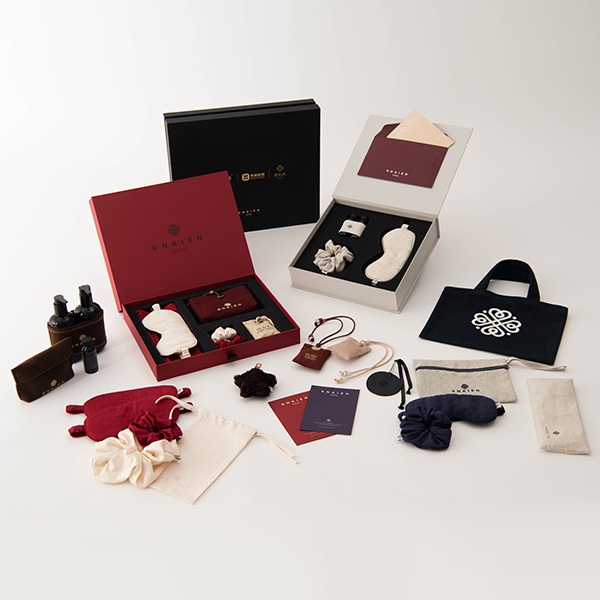
Guest Room Private Touchpoints: Including all daily necessities in guest rooms, such as custom logo coasters, laundry bags with embroidered brand names, fabric storage bags, tissue boxes, hanger tags, etc. Guests come into high-frequency contact with these items every day, and exquisite design can instantly enhance the living texture and root the brand impression in details.
Takeaway Souvenir Touchpoints: Such materials are the key to making the brand go beyond the hotel and achieve secondary communication, including custom cotton slippers, portable eye masks, toiletries sets, mini aromatherapy essential oils, niche gift boxes, etc. When guests take them away, they will see the brand again in daily life, which is equivalent to free mobile promotion and can also enhance the happiness of the stay.
Public Area Universal Touchpoints: Beach bags, brand paper bags, aromatherapy bottle packaging, check-out souvenirs, etc. A unified visual design can make the brand tone run through the whole process and avoid a messy feeling.
Key Practical Points The quality of small items directly determines the brand texture. Never pursue low prices and choose rough and inferior products, which will instead lower the brand grade. It is recommended to cooperate with professional custom suppliers (such as Kazan) to control materials, printing and workmanship, unify brand color matching and logo layout, achieve the goal of being small but refined, simple but beautiful, and turn every small item into a presentable brand business card.
2. Emotional Branding: Replacing Hard Advertising with Experience, Locking in Customers and Repeat Purchases with Emotional Value
Young high-end vacation travelers are no longer satisfied with just “having a place to stay”, but pursue accommodation experiences with emotional resonance, relaxation and healing, and a sense of exclusivity. The core of emotional branding is to break away from hard advertising, move guests with detailed and humanized experiences, and make hotels and homestays a haven for emotions rather than just accommodation spaces. **Core goal**: Let guests feel relaxed, healed and valued after check-in, and what they remember is not only the hotel’s environment but also this comfortable emotional experience, thus forming brand loyalty. Compared with spending a lot of money on online advertising, the investment cost of emotional value is lower, but the conversion rate and communication rate are higher. When guests feel the thoughtfulness and care, they will naturally take the initiative to repurchase and share spontaneously on social platforms, forming word-of-mouth fission. The core of implementation revolves around two directions:
Detailed and Thoughtful Experience Abandon the stereotyped standardized service and add exclusive details, such as preparing custom small souvenirs for different customer groups (couple-style aromatherapy, parent-child toys, portable stationery gift boxes for business travelers), handwritten welcome cards at the front desk, small snacks with turndown service, and special brewed tea or warm soup changed according to seasons, weakening the commercial sense and strengthening the human touch.
Creation of a Unified High-end Tone Adhere to a unified style in the overall vision and atmosphere, with minimalist style, blank design, low-saturation Morandi color system and log natural style being the mainstream recommendations. Avoid gaudy and complicated color matching and decorations, which can not only enhance the high-end sense of the space but also reduce the subsequent procurement and inventory management costs. Materials of the same style can be reused for a long time, reducing the replacement frequency.
3. Service Branding: Standardized Processes + Warm Service, Consolidating the Brand Foundation
Hospitality is the core soul of hotels and homestays. No matter how good the visual touchpoints and emotional experiences are, they all need high-quality services as support. Service branding emphasizes “standardization as the foundation and personalization as the bonus”, which not only avoids service confusion and process omissions but also prevents services from becoming rigid and cold, achieving both excellent visual texture and service quality. Many homestays easily fall into a misunderstanding: they only pay attention to soft decoration and material packaging while ignoring service norms, leading to a disconnection in the guest experience. A mature branded hotel or homestay must attach equal importance to service and vision. The specific implementation directions are as follows:
Standardization of Basic Service Processes Sort out the standard norms for the entire process from booking consultation, check-in reception, guest room cleaning, facility use to check-out after-sales service, clarify the service words and operation standards for each link, avoid problems such as delayed response, inadequate cleaning and neglected needs, and ensure the basic accommodation experience of guests.
On the basis of standardization, create exclusive characteristic services combined with the hotel’s positioning. For example, resort homestays provide surrounding travel guides and pick-up and drop-off services; parent-child homestays are equipped with children’s toiletries, toys and baby cribs; high-end hotels add exclusive member services, custom catering and afternoon tea; niche homestays offer handcraft experiences and morning exercise companionship, making the service memorable and different from homogeneous competitors.
Core Logic Visual materials are the “appearance” of a brand, and thoughtful and standardized services are the “essence” of a brand. The appearance attracts attention, and the essence retains guests. Only the combination of the two can build a truly competitive brand.
4. Story Branding: Endowing the Brand with a Soul, Creating a Unique Temperament
A brand without a story is ultimately an empty shell without a soul. Especially for niche homestays and characteristic hotels, story branding can make the brand break away from stereotyped commercialization and become warm, distinctive and memorable. Its core is to create an exclusive main story for the hotel or homestay, and let all designs, materials and services revolve around the story to form a complete brand system. A brand story does not need to deliberately fabricate flowery words, but should be combined with the inherent genes of the hotel or homestay, such as geographical location, architectural characteristics, the operator’s philosophy, design original intention, etc. Common main story themes include: mountain and wilderness nature, coastal vacation, urban seclusion, retro literature and art, local culture, minimalist art, pastoral slow life, etc. It only needs to be in line with its own reality, and never force a persona that is divorced from reality.
Full-scenario Penetration of Story Implementation After determining the main story, the brand color matching, logo design, material packaging, soft decoration style, service words and promotional copy all extend along the story. For example, a homestay focusing on “mountain and wilderness seclusion” adopts log green and earth tones as a whole, integrates landscape elements into materials, highlights seclusion and slow life in promotion, and features a quiet and free service style; a homestay focusing on “local culture” integrates local scenery and characteristic elements, and selects local characteristic handcrafts as souvenirs.
Weakening the Marketing Sense in Story Communication Naturally convey the story through public area ornaments, wall copy, the operator’s message and promotional content, rather than rigid sales promotion, allowing guests to actively perceive the brand connotation. Such a brand will not be rigid and stereotyped, but instead have a unique temperament and recognition, and be more likely to stand out among similar accommodations.
Brand building for hotels and homestays is not an overnight project, nor does it require a one-time large amount of capital investment. It is recommended that practitioners start with touchpoint branding and emotional details to optimize the brand texture quickly at low cost, then gradually improve service norms and sort out the exclusive brand story. The four techniques integrate with each other and flexibly adapt to their own positioning. By slowly accumulating brand word-of-mouth and equity, practitioners can gradually enhance brand value, break away from low-price involution and achieve long-term operation.